Vera Hartmann · 3 September 2026
How Wind Currents Shape Long-Term Strategies for Managing Online Platform Stability and User Flow
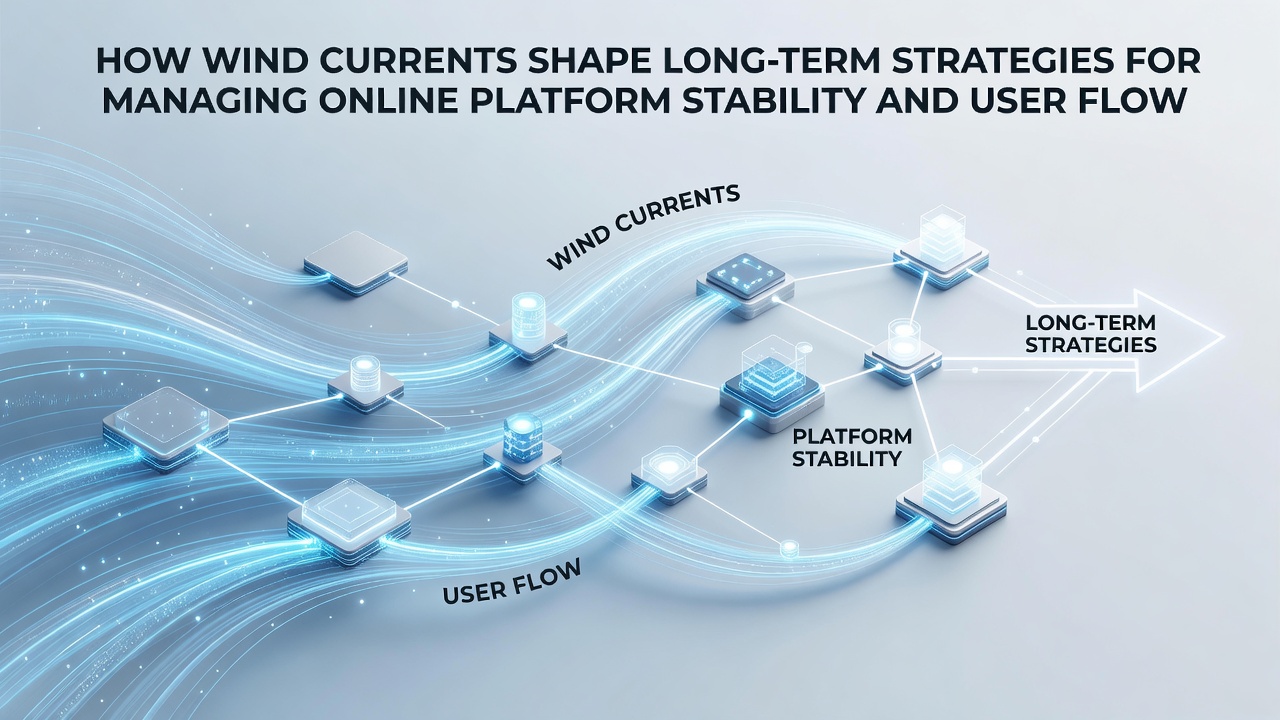
Wind currents serve as a useful analogy for the variable forces that move user traffic across digital networks, and platform operators track these patterns to build durable systems that maintain uptime while directing visitors smoothly through interfaces and services. Researchers at institutions focused on network engineering have documented how sudden shifts in demand resemble gusts that test structural integrity, prompting investments in distributed servers and predictive routing algorithms that adjust in real time. Data from multiple monitoring projects show that platforms using adaptive load balancing reduce downtime during peak surges by measurable percentages compared with static configurations.
Mapping External Forces to Platform Architecture
Operators analyze historical traffic logs alongside external indicators such as global event calendars and economic indicators because these elements create the equivalent of prevailing winds that push volumes toward certain regions or applications at predictable intervals. In September 2026 several research consortia plan to release updated models that incorporate satellite-derived climate data as proxies for long-range traffic forecasting, allowing engineers to pre-position capacity ahead of seasonal patterns. One study conducted across North American data centers found that integrating such forecasts lowered latency spikes by up to 18 percent during high-traffic windows.
Redundancy and Flow Regulation Mechanisms
Long-term strategies emphasize multiple layers of redundancy so that when one pathway experiences disruption another route absorbs the redirected flow without service interruption, much as jet streams divert around obstacles. Content delivery networks spread assets geographically while dynamic rate limiting prevents localized congestion from propagating across an entire system. According to guidance issued by the National Institute of Standards and Technology, platforms that embed these controls at the architectural level demonstrate higher recovery rates following simulated overload events.
Engineers also monitor edge-device telemetry to detect early signs of shifting user behavior, then trigger automated scaling policies that add or remove resources before queues form. This approach mirrors how atmospheric monitoring stations feed data into weather prediction models that guide aviation routing decisions days in advance.

Regional Regulatory Influences on Strategy Design
Government frameworks in different jurisdictions shape the parameters within which platforms can deploy these adaptive systems, and operators therefore maintain compliance teams that translate policy updates into technical requirements. A 2025 analysis prepared for the Australian Competition and Consumer Commission examined how data-localization rules affect routing efficiency and concluded that hybrid architectures balancing local and regional caches deliver both regulatory adherence and acceptable performance. Platforms operating across borders integrate these constraints into their planning cycles so that capacity decisions account for legal as well as technical variables.
Academic teams at European universities have published findings on machine-learning models that forecast user arrival rates with increasing accuracy, enabling finer control over server allocation and reducing energy consumption during low-demand periods. These models treat traffic fluctuations as stochastic processes comparable to turbulent airflow, applying similar statistical methods to generate probabilistic scenarios that inform capital expenditure schedules.
Case Examples from Operational Environments
One large-scale social platform implemented a centralized control plane that ingests real-time signals from thousands of endpoints and recalculates routing tables every few seconds; observers noted that the change produced steadier session durations even when external events drove sudden interest spikes. Another enterprise focused on e-commerce deployed container orchestration tuned to geographic demand gradients, achieving consistent checkout completion rates across multiple time zones. Such implementations illustrate how treating traffic as fluid dynamics rather than discrete events leads to different investment priorities over multi-year horizons.
Conclusion
Platform teams continue to refine their approaches by combining meteorological-style forecasting with rigorous infrastructure testing, thereby translating the lessons of wind current modeling into concrete improvements in stability metrics and user navigation success. Ongoing data collection from diverse geographic sources supplies the raw material for these iterative enhancements, ensuring that systems remain responsive to both anticipated adn emergent patterns of demand.