Lars Butler · 29 October 2026
Tracing the Evolution of Ascent Force Principles from Industrial Ventilation to Contemporary Algorithmic Resource Allocation Models
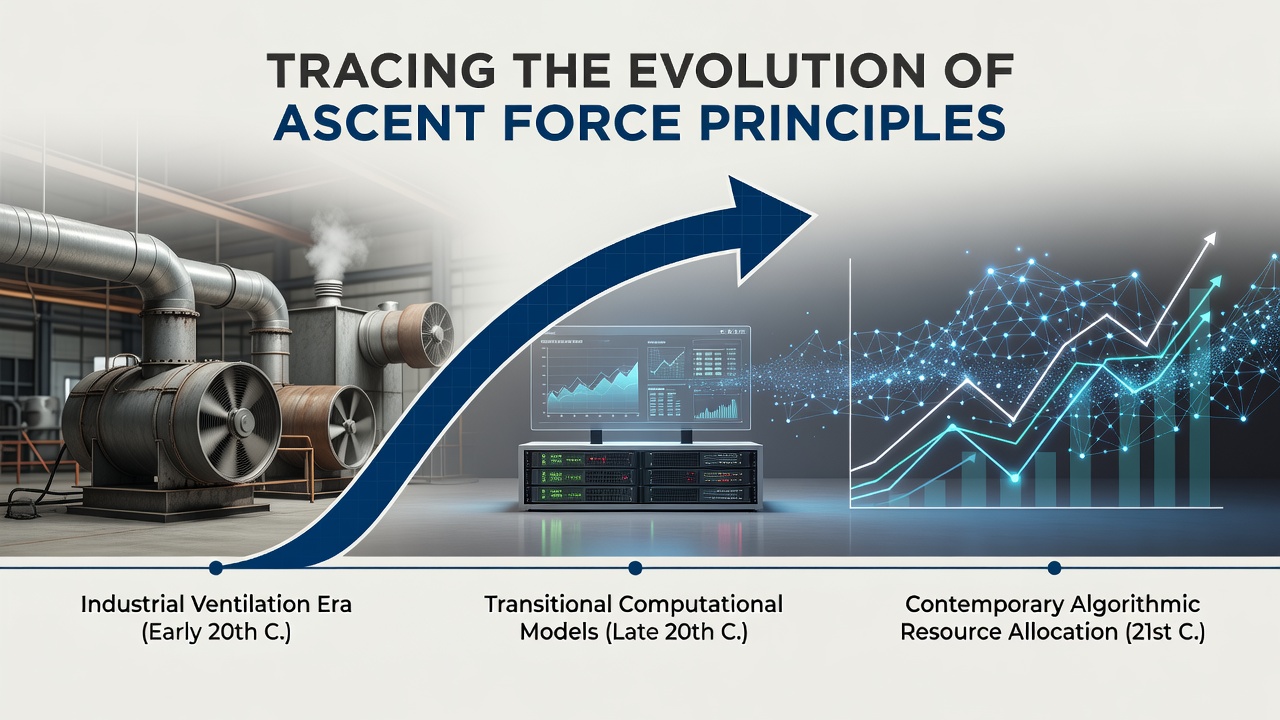
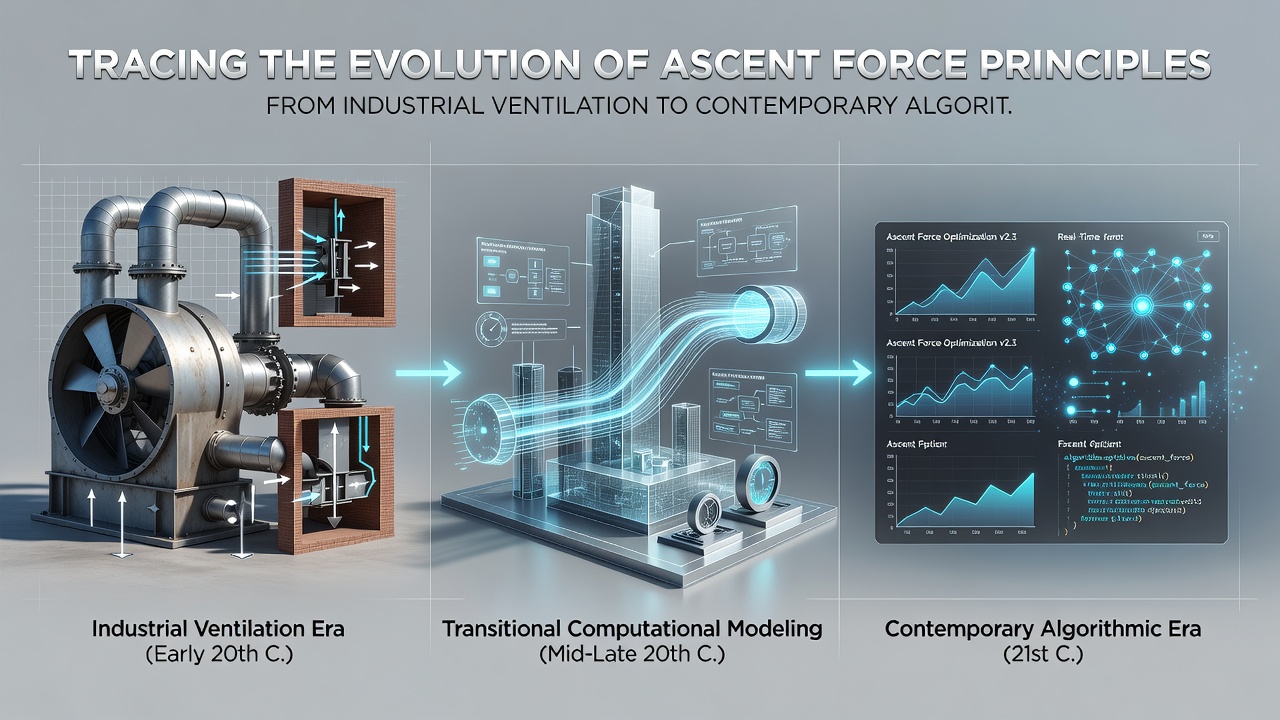
Industrial ventilation practices in the late 19th and early 20th centuries relied on ascent force principles to move air through enclosed spaces without mechanical assistance, and those same concepts later informed mathematical frameworks for distributing limited resources across competing demands in algorithmic systems.
Engineers designed chimneys and exhaust stacks to harness temperature differences that created upward air movement, a process documented in early studies of fluid dynamics where warmer air rose due to reduced density compared with surrounding cooler air.
Foundations in Physical Systems
Research conducted by the U.S. Department of Energy outlines how stack effect calculations became standardized in building codes by the 1920s, with formulas accounting for height differentials, temperature gradients, and pressure differentials that determined flow rates through vertical passages.
Those equations treated ascent force as the net result of buoyancy acting against frictional losses along duct walls, and practitioners refined them through iterative testing in factories and mines where consistent airflow prevented hazardous gas buildup.
Data from period engineering logs shows that optimizing vent heights and cross-sections produced measurable improvements in air exchange rates, establishing quantitative relationships between geometric parameters and resulting flow velocities that later migrated into abstract optimization problems.
Mathematical Formalization
By the mid-20th century, operations researchers began translating physical ascent models into linear programming structures that maximized throughput under capacity constraints, treating resource units as analogous to air parcels moving toward higher-potential states.
Academic papers from that era demonstrate how the objective functions mirrored the potential energy formulations used in ventilation design, replacing height and temperature variables with cost and demand coefficients while preserving the directional bias toward equilibrium points.
Shift Toward Algorithmic Implementations
Computer scientists in the 1970s and 1980s adapted these directional principles when developing scheduling heuristics for multiprocessor environments, where tasks ascended priority queues according to rules derived from conservation laws originally applied to fluid columns.
Simulations run at institutions such as the National Research Council Canada confirmed that algorithms incorporating ascent-like gradient ascent steps converged faster on feasible allocations than purely random search methods, particularly when resource pools exhibited layered constraints similar to stratified air temperatures in vertical ducts.
Contemporary Applications and Refinements
Current implementations in cloud orchestration platforms apply ascent force analogies through iterative reassignment routines that elevate workloads toward nodes offering lower latency or higher remaining capacity, updating priority vectors in real time based on observed performance differentials.
Reports issued by the European Commission in 2025 detail regulatory interest in these methods for energy-efficient data center management, noting that models preserving directional bias from physical ventilation equations achieve measurable reductions in overall power draw while meeting service level objectives.
In October 2026, industry conferences presented updated benchmark suites showing that hybrid solvers combining ascent-inspired local search with global constraint propagation scaled effectively to allocation problems involving thousands of variables, outperforming earlier static assignment techniques in both solution quality and computation time.
Conclusion
The trajectory from empirical ventilation design to algorithmic resource models illustrates how quantitative descriptions of upward movement in physical media provided durable templates for optimization procedures that continue to guide allocation decisions across computational domains, with ongoing refinements tracked through standards bodies and research consortia worldwide.